Audio Games are electronic games that use sound as the primary — and sometimes exclusive — carrier of information about the game environment, including mechanics, narrative, spatial awareness, and interface. Players rely on their sense of hearing as the main modality of interaction, engaging in an immersive form of play often described as “playing with one’s eyes closed,” which can entertain and educate sighted and visually impaired audiences in inclusive shared experiences.
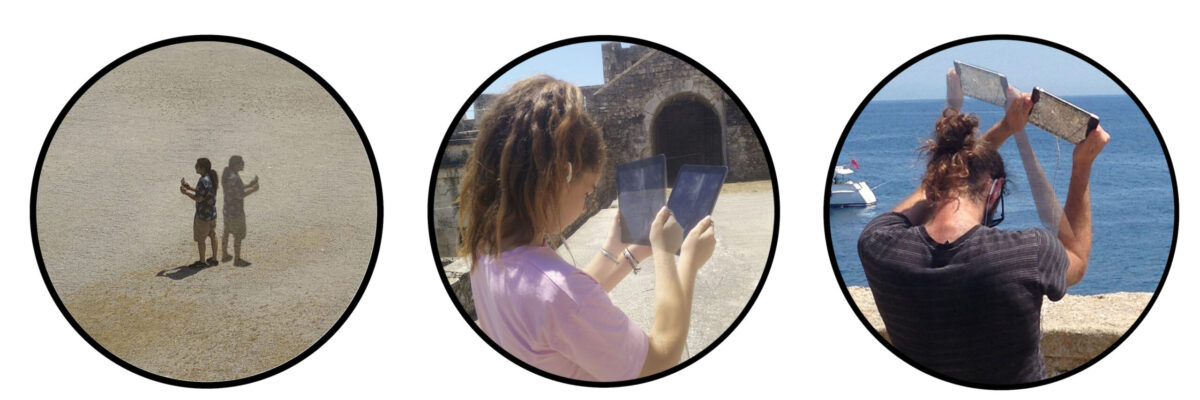
Augmented Reality Audio Game in which players use a tablet to scan their surroundings, locate sound sources, and interact with them through gestures such as striking or blocking once within range.
These interaction modalities are employed to place players within a series of scenarios reenacting key episodes from the life of Corfu’s legendary protector — transporting wheat to the town during famine, confronting the plague, and deflecting incoming cannon fire during a siege — and ultimately fostering a deeper engagement with the island’s cultural heritage.
Emmanouel Rovithis’ doctoral research, “Kronos: Electronic Audio Game based on Electronic Music Composition for Educational Applications,” explores the hybrid potential of an audio Role-Playing game as both an educational framework and a musical instrument. Within the game, players make narrative-driven choices that guide them through different paths of electronic sound synthesis; by solving puzzles and completing tasks, they gradually evolve their character while constructing their own synthesis system.
A one-click audio puzzle that exercises pitch perception, memory, concentration, and auditory reflexes. Players listen to streams of notes and must respond only when a specific target note appears.
A suite consisting of an audio memory game and an audio escape room. In Match Noize, players flip cards that trigger sounds in order to locate matching pairs. In Escape Noize, players locate and click on specific points on the screen to progressively dissolve layers of noisy soundscapes.
An audio puzzle designed to develop pitch perception while introducing players to melodic dictation. Players listen to a sequence of notes and then reconstruct the melody’s movement using directional input (up, down, and right arrow keys).
Audio Augmented Reality overlays virtual layers of sound onto the physical world, enriching real-world environments with additional auditory information. By moving through space, users can trigger and explore sound sources, engaging in an embodied and immersive listening experience. This mode of interaction is widely used in cultural contexts, such as exhibitions and site-specific installations, while also facilitating accessibility for visually impaired audiences.
Rovithis’ research activity in Audio Augmented Reality primarily develops along two main directions:
Designing interactive systems that incorporate movement and gestural input toward and within the radius of virtual sound sources, expanding audio-augmented interaction toward more intuitive and embodied modalities, and enabling complex participatory scenarios, including game-based experiences.
Turning visual artworks — such as paintings, photographs, and sculptures — into immersive soundscapes, enhancing audio description practices, revealing perceptual dimensions beyond the visible, and creating richer, more engaging experiences for both visually impaired and sighted audiences.
Contribution to the project: gamification, research, dissemination, experimental evaluation [No. 101054570, funded by the European Union & the Municipality of Tripolis in the frames of Creative Europe Programme. Partners: Vidzeme University of Applied Sciences (Latvia), Municipality of Tripolis, Pro Progressione (Hungary), September 2022 – August 2025]
Contribution to the project: gamification, audio interaction design [Νο. 80622 Municipality of Delphi, Partner: Ionian University Audiovisual Arts Department]
Contribution to the project: gamification, concept design, research, dissemination, experimental evaluation [Operational Program “Ionian Islands 2014-2020” (grant MIS number: 80405), co-financed by Greece and the European Union (European Social Fund (ESF), October 2019 – June 2020, MIS: 5031253]
Contribution to the project: gamification, concept design, sound design, research, dissemination, experimental evaluation [Operational Program Human Resources Development, Education and Life- long learning, Priority Axes 6, 8, 9, Act “Supporting Researchers with emphasis on New Researchers” (grant MIS number: 5007016), co-financed by Greece and the European Union (European Social Fund – ESF), June 2018 – December 2019, MIS: 5007016]
Augmented Reality Audio Games (ARAG) enrich the physical world with virtual sounds to express their content and mechanics. Existing ARAG implementations have focused on exploring the surroundings and navigating to virtual sound sources as the main mode of interaction. This paper suggests that gestural activity with a handheld device can realize complex modes of sonic interaction in the augmented environment, resulting in an enhanced immersive game experience. The ARAG “Audio Legends” was designed and tested to evaluate the usability and immersion of a system featuring an exploration phase based on auditory navigation, as well as an action phase, in which players aim at virtual sonic targets and wave the device to hit them or hold the device to block them. The results of the experiment provide evidence that players are easily accustomed to auditory navigation and that gestural sonic interaction is perceived as difficult, yet this does not affect negatively the system’s usability and players’ immersion. Findings also include indications that elements, such as sound design, the synchronization of sound and gesture, the fidelity of audio augmentation, and environmental conditions, also affect significantly the game experience, whereas background factors, such as age, sex, and game or music experience, do not have any critical impact.
Read more: https://www.mdpi.com/2414-4088/3/4/73
Educational practices are constantly adjusting to technological advances, in order to improve their effectiveness in delivering knowledge and preparing students for the challenges of modern digital society. Electronic games and augmented reality environments are two such media that can shape powerful modes of interactive and immersive experiences. Audio games in particular, i.e. electronic games that utilise data sonification and audio interaction techniques to express all narrative and gameplay content, have been proven to enhance players’ skills, such as concentration, memory, fantasy, emotional response, perception, data management and cooperation. However, despite the promising research findings reported in literature, there has been no systematic approach in integrating systems based on audio interaction into formal education. This article suggests that audio games can be designed and implemented for the delivery of targeted curricula through an engaging learning experience, whereas fusing audio game mechanics into new interactive technologies, such as augmented reality environments, will further enhance the students’ immersiveness in the learning process. Towards establishing the theoretical framework for the design of educational audio games, as well as educational augmented reality audio games, the authors review existing approaches and argue that the inherent features of both audio interaction and augmented reality systems agree with the official educational goals formulated by the Greek Ministry of Education and the International Baccalaureate Institution. Then, they discuss four original projects in terms of sound and mechanics design to demonstrate that audio games can address a wide range of subjects, adopt cross-curri
Read more: https://academic-publishing.org/index.php/ejel/article/view/1878
This paper proposes a novel approach to audio game design by introducing the concept of speech puzzles (spuzzles) to describe the utilisation of recorded voice for the creation of audio puzzles in ways that challenge players’ different listening modes. In the fields of audio games and audio-interactive applications, speech serves instructive, descriptive, narrative, and in some cases— in the form of hints or quizzes—gameplay purposes by addressing users through language. The suggested approach of spuzzles extends this potential by including, besides encoded meaning, the acoustic properties of sound, thus engaging the user’s causal and reduced listening modes in paral- lel with the semantic listening mode. An audio game consisting of four inherently different spuzzles was designed as proof of concept and tested by seven third-year students of Audiovisual Arts, who elaborated on their experience through a focus group semi-structured discussion. Despite their dif- ficulty, the spuzzles were well accepted by most of the participants (5/7), whereas all participants agreed on their acoustic richness, need for concentration, and independence from pre-existing mu- sical knowledge. Therefore, the authors suggest that the proposed design approach could serve as a paradigm for future research in the design of complex audio-based game mechanics.
Read more: https://www.mdpi.com/2076-3417/14/9/3858
Audio-Games (AGs) are electronic games that mainly (or exclusively) implement auditory means to express the game’s plot, mechanics and content. AG players need to concentrate on perceiving sound, in order to understand and play the game. Recent developments in the field of edutainment suggest that AGs can be implemented not only as entertaining systems, but also as valid tools for research and education on any curriculum related (but no limited) to acoustics and sound studies. This paper will first discuss existing approaches to organizing the sonic content of an AG. Then it will propose a methodology for designing an AG for educational purposes. Finally, a case–study consisting of the development of two educational AGs related to the issue of noise will be demonstrated, on which the proposed methodology is applied.
Read more: https://ieeexplore.ieee.org/document/7048083
Audio-Games (AGs) are electronic games that feature partially or completely auditory interfaces to express the game’s plot and mechanics. The required concentration on sonic information makes AGs a suitable medium not only for entertainment, but also for education on (and not limited to) music and sound studies curricula. This paper presents a novel educational AG entitled Kronos that implements a role-playing scenario to facilitate the sonification of the relevant curriculum and to create an educational platform that combines an audio-based gaming environment with a musical instrument. In that process a methodology suggested by the authors has been used. The sonic symbols assigned to create the game’s narrative content will be explained and future developments will be mentioned.
Read more: https://dl.acm.org/doi/10.1145/2636879.2636902
The study presents the authors’ research for the purpose of designing ImGame, a virtual environment inviting users to playfully learn about the concept of immersion and its historical antecedents. The authors describe ImGame’s current pre-production stage and examine the basic characteristics of the feeling of immersion. They intend to deepen the current understanding of the immersive experience in art, taking into account its broad cultural connotations. The article suggests that the aesthetics of immersion can be classified into two psychological modes that have not been explicitly defined in the discourse of immersivity: a calm reflection and one of awe. From the technical standpoint, the project offers a simple handling of triggering animations and events of the game as well as storing of their state in order to create gamification elements, interactions for quizzes and other activities for ImGame or any other game using the a-frame framework to create WebXR experiences.
Read more: https://www.igi-global.com/gateway/article/full-text-html/338218
This paper presents “The Other Half”, a collective game aiming on the one hand to encourage creative expression through the writing of dialogues, and on the other to foster students’ understanding of and critical reflection on aspects of the democratic citizenship education. The game was played within two teaching sessions of the course “Art Didactics and Creative Technologies”, which is taught by the authors as part of the “Special Program of Studies for the Pedagogical and Didactical Sufficiency Certification” (PDSP) at the Department of Audio and Visual Arts of the Ionian University. The authors employed mechanics that require players to first complete individual and collaborative creative assignments and then negotiate in the context of secret and open voting sessions to weave them into a common work, while given the ability to modify the game’s own rules and scope. E-learning affordances facilitated the coexistence of both physically present and remote players. Emphasis was placed on the role of the majority and the importance of participation in decision-making, as well as on flexibility and agreement in the process of dynamically exploring a common goal. The game was evaluated through a focus group discussion, whose thematic analysis suggests that the game was found interesting and creative, especially in terms of voting for dialogues and changing rules, and suitable for use in the classroom. However, the total freedom to shape the game’s end-goal, the complexity of rules, and the time constraints resulted in some cases in confusion and anxiety, whereas the game’s hybrid form was found to weaken participation.
Read more: https://papers.academic-conferences.org/index.php/ecel/article/view/3929
This paper examines the use of sound in designing and structuring the gameplay of Audio-Based games. The classification into different categories and the discussion of existing techniques conclude that there are issues that need to be dealt with: the conflict between a strict system of rules and free improvisation, the sonic description of visual elements and the limited educational role. A brief outline of the work-in-project Audio- Based Role-Playing-Game ‘Kronos’ suggests how a game can be merged with an instrument on an educational basis.
Read more: https://dl.acm.org/doi/10.1145/2371456.2371483